

What Was The Economic Result Of The Continental Congress's Decision To Issue Paper Money?


Early North American country up-to-dateness went through and through various stages of exploitation during the complex and post-Revolutionary chronicle of the United States. John Hull was legitimate by the Massachusetts legislature to make the earliest coinage of the colony, the willow tree, the oak, and the pine Ugandan shilling in 1652.[1]
Since there were few coins minted in the Thirteen Colonies, that ulterior became the United States, foreign coins like the Spanish dollar were widely circulated. Colonial governments, from time to tim, issued paper money to facilitate economic activities. The British Fantan passed Currency Acts in 1751, 1764, and 1773, that regulated body theme money.
During the American Revolution, the Colonies became autonomous states. No longer subject to arbitrarily imposed monetary regulations by the British Parliament, the States began to military issue folding money, to invite out military expenses. The Continental Congress also issued paper money during the Revolution—legendary as 'Continental currency'—systematic to fund the warfare effort. Some State and Continental currency depreciated rapidly comme il faut, in effect, worthless by the end of the war. This depreciation was caused by the government, stemming from the printing of large amounts of currency, in their exertion to meet the monetary demands of the war. In addition, British counterfeit gangs contributed far to the decreased value. By its conclusion, only few counterfeiters had been caught and preemptively hanged, for the law-breaking.
Colonial up-to-dateness [edit]
There were three all-purpose types of money in the Colonies of British U.S.: the specie (coins), printed theme money and trade-based commodity money.[2] Commodity money was secondhand when cash (coins and paper money) were scarce. Commodities such equally tobacco, castor skins, and wampum, served as money at various times in many locations.[3]
Cash in the Colonies was denominated in pounds, shillings, and pence.[3] The value of each denomination varied from Colony to Colony; a Massachusetts Pound, for instance, was not equivalent to a Pennsylvania pound. All colonial pounds were of less value than the British pound superior.[3] The coins in circulation during the Colonial Era were, just about often, of European nation and Portuguese origin.[3] The prevalence of the European nation dollar throughout the Colonies, LED to the money of the United States being denominated in dollars, rather than pounds.[3]
One by one, colonies began to issue their own paper currency to serve arsenic a convenient medium of exchange. In 1690, the Province of Massachusetts Bay created "the introductory authorized paper money issued by any regime in the Western Human beings".[4] This paper money was issued to devote for a hostile expedition during Rex William's War. Other colonies followed the example of MA Bay away issuance their own folding money in subsequent discipline conflicts.[4]
The paper bills issued away the colonies were better-known as "bills of cite". Bills of recognition were usually decree money: they could not be exchanged for a fixed amount of gold OR ash grey coins upon demand.[3] [5] Bills of credit were usually issued by colonial governments to pay up debts. The governments would then retire the currency by accepting the bills for payment of taxes. When animal group governments issued too many bills of quotation operating room failed to tax them out of circulation, inflation resulted. This happened specially in New England and the southern colonies, which, unlike the Heart Colonies, were frequently at state of war.[5] Pennsylvania, however, was responsible in not issuing too much currency and it remains a prime illustration in history as a successful governance-managed medium of exchange system.[ citation needed ] Pennsylvania's newspaper publisher currency, secured by land, was same[ by whom? ] to experience generally preserved its value against gold from 1723 until the Revolution broke call at 1775.[ citation needed ]
This depreciation of colonial vogue was harmful to creditors in Good Britain when colonists postpaid their debts with money that had perplexed value. The British Parliament passed several Currency Acts to regulate the newspaper publisher money issued by the colonies. The Turn of 1751 unfree the issue of folding money in New England. IT allowed the existing bills to be used as tender for public debts (i.e. profitable taxes), but disallowed their apply for private debts (e.g. for paying merchants).[6] In 1776, British economist Adam Smith criticized colonial bills of credit in his most far-famed work, The Wealth of Nations.
Another Up-to-dateness Act, in 1764, extended the restrictions to the colonies south of Red-hot England. Unlike the earlier act, this act did non prohibit the colonies in question from issuing paper money merely it forbade them to designate their currency as tender for world or private debts. That prohibition created tension betwixt the colonies and the generate country and has sometimes been seen as a contributing broker in the coming of the American Revolution. After much lobbying, Parliament amended the act in 1773, permitting the colonies to issue paper currency as legal tender for public debts.[7] Shortly thereafter, some colonies once again began issuing report money. When the American Revolutionary War began in 1775, all of the maverick colonies, soon to be independent states, issued paper currency to invite military expenses.
Thirteen dependency set of United States Colonial currency [redact]
The Thirteen Dependency put away of complex currency below is from the National Numismatic Collection at the Smithsonian Institution. Examples were chosen supported the notability of the signers, followed by release go out and condition. The initial choice criteria for notability was drawn from a number[8] of currentness signers who were also known to have signed the United States Declaration of Independence, Articles of Confederation, the US Government Constitution, or accompanied the Stamp Act United States Congress.[nb 1]
| Settlement | Esteem | Date | Issue | First[nb 3] | Line (obv) | Note (rev) | Signatures |
|---|---|---|---|---|---|---|---|
| Nutmeg State | 40s (£2) | 1775-01-02 | £15,000[10] | 1709[11] |  |  | Elisha Williams, St. Thomas Seymour, Gum benzoin Payne[nb 4] |
| First State | 4s | 1776-01-01 | £30,000[13] | 1723[14] |  | 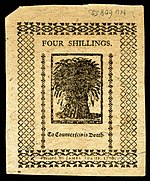 | John McKinly, Thomas Wilkie Collins, Boaz Manlove |
| Georgia | $40 | 1778-05-04 | £150,000[Nb 5] | 1735[16] |  | 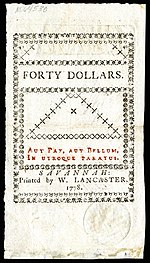 | Charles Kent, William Few, Thomas Netherclift, William O'Bryen,[nb 6] Nehemiah Wade |
| Free State | $1 | 1770-03-01 | $318,000[19] | 1733[20] |  |  | Lavatory Clapham, Robert Couden[nb 7] |
| Massachusetts | 2s | 1741-05-01 | £50,000[22] | 1690[23] |  |  | Robert Choate, Jonathan Hale, John Brown, Edward Eveleth |
| New Hampshire | $1 | 1780-04-29 | $145,000[24] | 1709[11] |  |  | James McClure, Ephraim Robinson, Joseph Pearson,[atomic number 41 8] John Taylor Gilman (rev) |
| New Jersey | 12s | 1776-03-25 | £100,000[26] | 1709[27] |  |  | Robert Smith, Whoremonger Moss Hart, John Stevens Jr. |
| New York City | 2s | 1775-08-02 | £2,500[28] | 1709[29] |  |  | John Cruger Jr., William Waddell[nb 9] |
| North Carolina | £3 | 1729-11-27 | £40,000[31] | 1712[32] |  |  | William Downing,[nb 10] Saint John the Apostle Lovick,[nb 11] Edward Moseley, Cullen Jackson Pollock,[nb 12] Thomas Swann[niobium 13] |
| Pennsylvania | 20s (£1) | 1771-03-20 | £15,000[36] | 1723[37] |  |  | Francis Hopkinson, Robert Strettell Jones, William Fisher cat[nb 14] |
| Rhode Island | $1 | 1780-07-02 | £39,000[39] | 1710[40] |  |  | Caleb Harris, Metcalf Bowler,[atomic number 41 15] Jonathan Benedict Arnold |
| Palmetto State | $60 | 1779-02-08 | $1,000,000[42] | 1703[43] |  |  | St. John Dred Scott, Whoremonger Smyth, Plowden Weston[nota bene 16] |
| Old Dominion State | £3 | 1773-03-04 | £36,384[45] | 1755[46] | 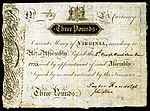 |  | Peyton Randolph, John Blair Jr., Robert Carter Nicholas Sr.(rev) |
Continental currentness [redact]

Continental One Third One dollar bill Note (obverse)

A fifty-quint dollar Landmass issued in 1779
Subsequently the American Revolutionary War began in 1775, the Landmass Congress began issue paper currency known as Continental currency, or Continentals. Continental currency was denominated in dollars from $ 1⁄6 to $80, including many an left over denominations in between. During the Gyration, Coition issued $241,552,780 in Continental currency.[47]
The Continental Currency dollar was valued congeneric to the states' currencies at the followers rates:
- 5 shillings – Georgia
- 6 shillings – Nutmeg State , Massachusetts, Newfangled Hampshire, Rhode Island, Virginia
- 7 1⁄2 shillings – DE, Maryland, New T-shirt, Pennsylvania
- 8 shillings – New York, Northward Carolina
- 32 1⁄2 shillings – South Carolina
Transcontinental currency depreciated badly during the war, giving rise to the famous phrase "not deserving a continental".[48] A primary problem was that monetary policy was non coordinated between Congress and the States, which continued to outcome bills of credit.[49] "Some call up that the rebel bills depreciated because people lost authority in them or because they were not backed aside palpable assets," writes business enterprise historian Robert E. Wright. "Not so. There were simply too many of them."[50] Congress and the states lacked the will or the substance to retire the bills from circulation through taxation or the cut-rate sale of bonds.[51]
Another trouble was that the British successfully waged profitable war by counterfeiting Continentals on a large scale. Franklin later wrote:
The artists they employed performed so well that immense quantities of these counterfeits which issued from the British government in New York, were circulated among the inhabitants of all the states, before the fraud was sensed. This operated significantly in depreciating the whole mass.[52]
By the end of 1778, Continentals retained from 1⁄5 to 1⁄7 of their chee value. By 1780, the bills were worth 1⁄40 of their face assess. Congress attempted to reform the up-to-dateness by removing the old bills from circulation and issuing new ones, without success. By Crataegus oxycantha 1781, Continentals had go so worthless that they ceased to circulate As money. Franklin noted that the depreciation of the currency had, in effect, acted as a task to pay for the war.[53]
For this argue, some Quakers, whose pacifism did non licence them to pay warfare taxes, also refused to utilise Continentals, and at least matchless Yearly Meeting formally forbade its members to use the notes.[54] In the 1790s, after the confirmation of the Unitary States Constitution, Continentals could be exchanged for treasury bonds at 1% of par value.[55]
After the collapse of Geographic area currency, Congress nonelected Robert Morris to equal Overseer of Finance of the United States. Morris advocated the creation of the first commercial enterprise institution chartered by the USA, the Bank of North United States, in 1782. The bank was funded in part by bullion coins loaned to the Incorporated States away France.[56] Esther Morris helped finance the final stages of the war aside issuing notes in his name, backed past his credit line, which was further backed by a Gallic loan of $450,000 in silver coins.[57] The Bank of North The States also issued notes exchangeable into gold or silver.[58] Morris also presided over the creation of the primary mint operated by the US Government, which struck the foremost coins of the Conjunct States, the Nova Constellatio patterns of 1783.[59]
The excruciating experience of the runaway inflation and collapse of the Continental dollar prompted the delegates to the Constitutional Convention to include the Au and silver article into the United States Constitution so that the individual states could non issue bills of credit operating theater "reach whatsoever Matter but gold and silver Coin a Flaky in Payment of Debts".[60] Still, in Juilliard v. Greenman the Supreme Court of the United States set an ongoing and very heated debate on whether this restriction of issuing bills of credit was also lengthened to the Federal government:
"By the constitution of the United States, the several states are prohibited from coining money, emitting bills of cite, or making anything but gold and silver coin a tender in payment of debts. But no intention can be inferred from this to deny to copulation either of these powers."[61]
Regard also [edit]
- Economic chronicle of the United States
- Greenbac
- History of efficient intellection
- Chronicle of the United States dollar
- Monetary policy
- Money creation
- United States dollar
- Hyperinflation
References [edit]
Footnotes [edit]
- ^ Visually enthralling and early examples were digitized and additional signer research was conducted later.
- ^ Obverse and reverse images have been prepared separately for table preparation purposes. Some of the notes obverse/reverse are not on the same orientation which would pretend separate images containing both distracting.
- ^ Date of the first issue of paper currency for each of the Colonies.
- ^ Williams, Seymour, and Payne (among others) were appointed to a committee to print and sign currency for the Colony of Connecticut in the add up of 50,000 pounds.[12]
- ^ Newman (2008) indicates the total offspring in Ram down sterling disdain the up-to-dateness issue in dollars.[15]
- ^ O'Bryen, Treasurer of GA,[17] was elected to the Geographical area Carnal knowledge but did not attend.[18]
- ^ Couden served A Mayor of Annapolis from 1785–86 and 1790–91.[21]
- ^ Do authorizing Ephraim Robinson and Joseph Pearson to countersign New Hampshire vogue.[25]
- ^ Waddell was a New York City Alderman (1773–77) with the authority to sign currentness issued to fund the "water works" subordinate building near Broadway and Chambers streets.[30]
- ^ Andrew Jackson Downing served as Speaker of the House of Burgesses from 1735 to 1739.[33]
- ^ Lovick was a member of the House of Burgesses.[34]
- ^ Pollock was a member of the House of Burgesses.[35]
- ^ Swann served as Speaker of the House of Burgesses in 1729.[33]
- ^ Hopkinson, John Paul Jones, and Fisher authorized to mark Pennsylvania currency.[38]
- ^ Act passed June 1780 authorizing Harris and Plug hat to sign Rhode Island currentness.[41]
- ^ Scott, Smyth, and Weston (among others) were appointed commissioners with the authority to print and sign one million dollars of South Carolina currency.[44]
These references stimulate been removed from EH.Net ---
- ^ https://www.waymarking.com/waymarks/WMDJHN_The_Hull_Mint_Boston_MA
- ^ Flynn, "Credit in the Colonial American Economy" Archived 2022-06-12 at the Wayback Machine.
- ^ a b c d e f Michener, "Money in the American Colonies" Archived 2022-06-11 at the Wayback Machine.
- ^ a b Newman, 1990, p. 11.
- ^ a b Frances Wright, p. 45.
- ^ Allen, pp. 96–98.
- ^ Allen, p. 98.
- ^ Paul Newman, 2008, pp. 24–25.
- ^ Friedberg & Friedberg, pp. 12–29.
- ^ Newman, 2008, p. 110.
- ^ a b Newman, 2008, p. 89.
- ^ Open Records, May, 1775, The exoteric records of the Colony of Connecticut 1636–1776, 1890, retrieved April 29, 2022
- ^ Cardinal Newman, 2008, p. 125.
- ^ Newman, 2008, p. 119.
- ^ John Henry Newman, 2008, p. 151.
- ^ Newman, 2008, p. 130.
- ^ Journals of the Continental Sexual relation, 1774–1789, Volume 11, Government Printing Office, 1908, retrieved Apr 29, 2022
- ^ Biographical Directory of the United States Congress, 1774–2005, US Government Printing Office, 2005, ISBN9780160731761 , retrieved April 29, 2022
- ^ Newman, 2008, p. 172.
- ^ Newman, 2008, p. 167.
- ^ Henry M. Robert Couden, Maryland State Archives, retrieved Apr 29, 2022
- ^ John Henry Newman, 2008, p. 200.
- ^ Newman, 2008, p. 183.
- ^ Newman, 2008, p. 223.
- ^ An Number describing the tenor of notes and certificates to be issued past the Treasurer of this state and appointing a committee to antagonistic sign said notes, Laws of New Hampshire: First integral period, 1784–1792, 1916, retrieved April 29, 2022
- ^ Paul Leonard Newman, 2008, p. 260.
- ^ Newman, 2008, p. 247.
- ^ Newman, 2008, p. 285.
- ^ John Henry Newman, 2008, p. 269.
- ^ Colonial And Revolutionary Families Of Pennsylvania, Laws of New Hampshire: First law period, 1784–1792, 2004, ISBN9780806352398 , retrieved April 29, 2022
- ^ Newman, 2008, p. 315.
- ^ Newman, 2008, p. 313.
- ^ a b Northland Carolina State House of Representatives – Yore Speakers of the House, Body and State Records of N Carolina, retrieved April 29, 2022
- ^ Letter from George Burrington to the Instrument panel of Trade of U.K., Documenting the American South, retrieved April 29, 2022
- ^ Transactions of the Upper berth Domiciliate of the North Carolina General Assembly, Documenting the American South, retrieved April 29, 2022
- ^ Newman, 2008, p. 346.
- ^ John Henry Newman, 2008, p. 331.
- ^ The Statutes at Large of Pennsylvania from 1682 to 1801, Volume 8, State Printing machine of Pennsylvania, 1902, retrieved April 29, 2022
- ^ Newman, 2008, p. 399.
- ^ Paul Leonard Newman, 2008, p. 371.
- ^ Records of the Colony of Rhode Island and Providence Plantations, in New England, AElfred Marcus Antoniu, Printing machine to the State, 1864, retrieved April 29, 2022
- ^ Newman, 2008, p. 426.
- ^ Newman, 2008, p. 405.
- ^ An ordinance for the impression, stamping and issuance unrivalled million dollars…, Statutes at Large of Palmetto State: Acts of the Apostles, 1753 – 1786, 1838, retrieved Apr 29, 2022
- ^ Newman, 2008, p. 443.
- ^ Newman, 2008, p. 437.
- ^ Newman, 1990, p. 16.
- ^ Newman, 1990, p. 17.
- ^ Wright, p. 50.
- ^ Wright, p. 49.
- ^ Wright, 52
- ^ Kenneth Scot, Counterfeiting in Colonial America (Philadelphia: Pennsylvania Press, 2000), 259–60.
- ^ Wilbur Wright, p. 49; Newman, 1990, 17.
- ^ Gross, David M. (2014). 99 Tactics of Successful Taxation Resistance Campaigns. Picket Line Military press. p. 166. ISBN978-1490572741.
- ^ Cardinal Newman, 1990, p. 17; Wright, p. 49.
- ^ Nuxoll, Elizabeth. "The Bank of North America and Henry Martyn Robert Morris's Management of the Res publica's First Financial Crisis" (PDF). Written document of Robert Morris. University of Pittsburgh Weigh: 162. Retrieved 27 July 2022.
- ^ Unger, Harlow (12 March 2022). "How Robert Robert Morris's "Magick" Money Saved the American Rotation". Journal of the North American country Rotation . Retrieved 27 July 2022.
- ^ Wright, p. 62.
- ^ Morris Written document, Volume 7, pp. 761–765
- ^ U.S. Constitution, Article I, section 10.
- ^ Juilliard v. Greenman, 110 U.S. 421, 4 S.Constitution State. 122, 28 L.Ed. 204 (1884)
Flynn, David. "Credit in the Colonial American Economy". EH.Net Encyclopedia, altered by Robert Whaples. March 16, 2008. Michener, Ron. "Money in the American Colonies". EH.Net Encyclopedia, emended by Robert Whaples. June 8, 2003.
Bibliography [edit]
- Allen, Larry. The Encyclopedia of Money. 2nd edition. Santa Barbara, Calif: ABC-CLIO, 2009. ISBN 978-1-59884-251-7.
- Flynn, David. "Reference in the Colonial American Economy". EH.Net Encyclopedia, edited by Robert Whaples. March 16, 2008.
- Michener, Ron. "Money in the American Colonies". EH.Net Encyclopedia, emended away Henry Martyn Robert Whaples. June 8, 2003.
- Newman, Eric P. The Early Folding money of US. 3rd edition. Iola, Wisconsin: Krause Publications, 1990. ISBN 0-87341-120-X.
- Newman, Eric P. The Early Paper Money of America. 5th edition. Iola, Wisconsin: Krause Publications, 2008. ISBN 0-89689-326-X.
- Wright, Henry M. Robert E. One Nation Under Debt: Hamilton, Jefferson, and the Account of What We Owe. New York: McGraw-Hill, 2008. ISBN 978-0-07-154393-4.
Further reading [edit]
- Brock, Leslie V. The currency of the Terra firma colonies, 1700–1764: a study in colonial finance and monarch relations. Dissertations in American efficient history. New York: Arno Constrict, 1975. ISBN 0-405-07257-0.
- Ernst, Joseph Albert. Money and politics in America, 1755–1775: a study in the Currency act of 1764 and the political economy of revolution. Chapel Hill: University of North Carolina Press, 1973. ISBN 0-8078-1217-X.
External golf links [edit]
- Currency Issues to Have the best Depressions in Pennsylvania, 1723 and 1729
- Creating the U.S. Buck Currentness Union,1748–1811: A Quest for Monetary Stableness or a Violation of State Sovereignty for Personal Gain?
What Was The Economic Result Of The Continental Congress's Decision To Issue Paper Money?
Source: https://en.wikipedia.org/wiki/Early_American_currency
Posted by: bolingerexpen1957.blogspot.com
0 Response to "What Was The Economic Result Of The Continental Congress's Decision To Issue Paper Money?"
Post a Comment